Condé Nast
Condé Nast Traveler
UX and UI design across article templates and browsing journeys, improving content discovery and engagement.

Background and context
Condé Nast Traveler is the industry leader in luxury travel journalism. Following the merger of Condé Nast and Condé Nast international, their brands were undergoing a 'digital unification', by migrating their brands onto a single platform.
Condé Nast Traveler was included in this digital transformation. However - whilst all markets were being migrated onto a single platform, we also took the opportunity to consider how CNT (North America) could better serve its users.
With the emphasis on finding other revenue streams (not just depending on advertising), the decision was made to focus more on affiliate marketing - by getting users down the hotel booking funnel via CNT's hotel reviews.
Role and approach
As Design Lead, my remit was to work with the UX Designer on a revised information architecture and a new global experience platform. We wanted to ensure that CNT could serve users before and during their holiday experience. Additionally, we'd want the users to come back and use CNT for their future travels.
We structured the offering around a clear editorial framework: where to go, where to eat, where to stay and what to do. Through site analytics, editorial were able to better understand which locations were the most important, which would drive future content creation decisions.
I introduced Condé Nast's first mega menu, surfacing content that had previously been buried layers deep. We surfaced sections such as 'Readers Choice Awards', together with other 'best of' and annual 'Hot Lists' editorially led articles with booking CTA's clearly presented. SEO was central to the site structure, ensuring that all pages and content had relevant titles, keywords and meta.
Outcome
CNT (US market) adopted the global designs, and positive results were immediate. Search traffic went up +23% YoY, as a result of ongoing City Guide refreshes. Affiliate clicks increased +58.36% QoQ due to a 3% increase in merchants and growth across a number of retailers including a +49% increase from Expedia, +110% from Amazon, and +41% increase from Airbnb Demand Program.
The foundation we set proved to be a success, and with all new components and page templates now part of the unified design system, other markets could follow suit as they migrate onto the new platform with confidence.
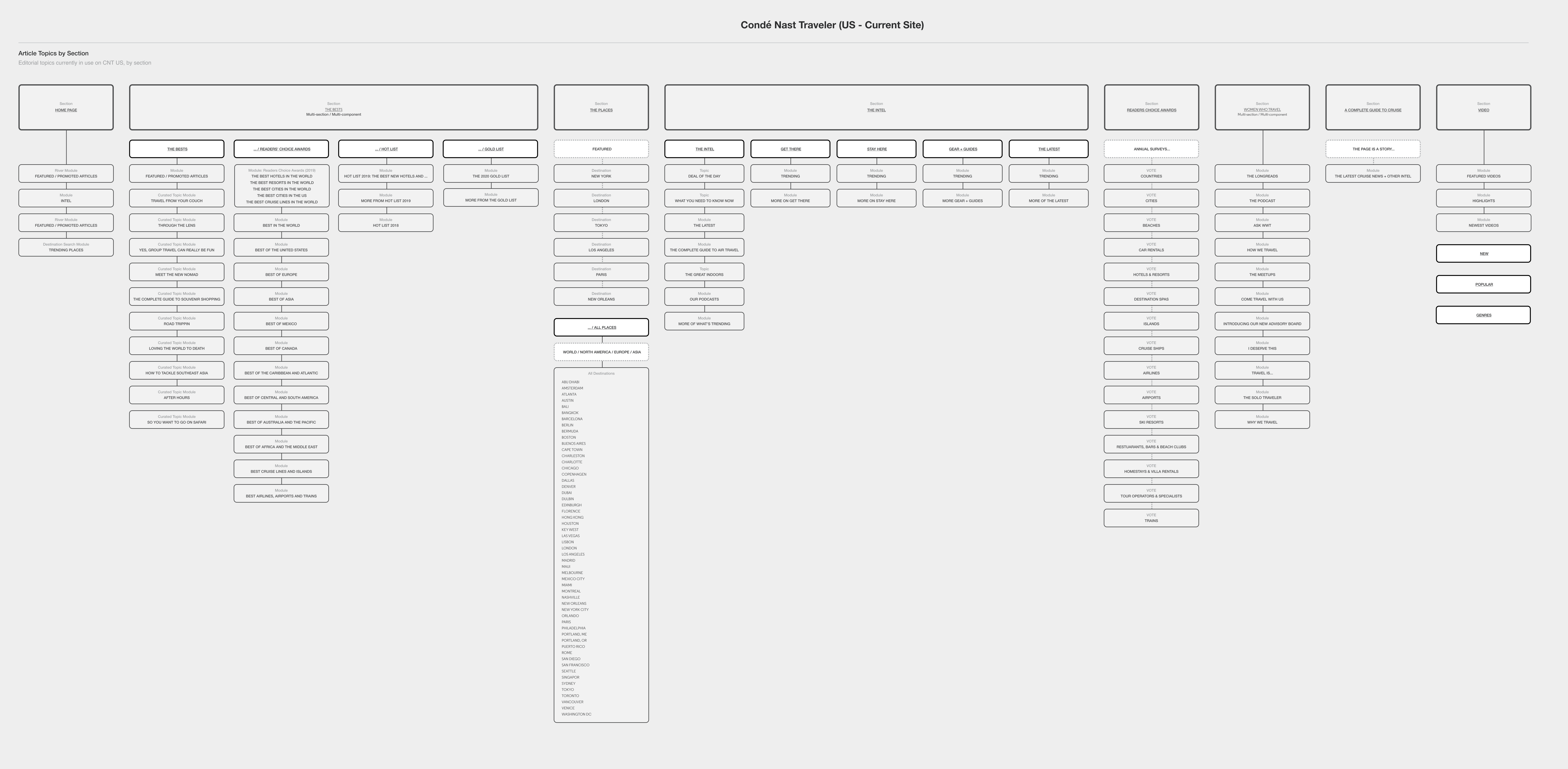
An IA audit of CNT before the update.
I started the project by conducting an IA audit of exisiting content. This would clarify the depth & type of content available to factor into an updated experience.
I then mapped out the depth of content from macro to micro regions. This then went on to determine the type of destination pages, mapping major to minor coverage. This went on to determine the structure of destination based pages.

Determining heirarchical geographic levels to explore where location based content can run deepest.
With a clear foundation established, I then produced a clear, consistent page structure for macro through to micro level destination pages. This enabled the user to be guided from top level region pages, through to specific destinations.
Once a user was engaged in a specific location, actionable content such as 'Where to stay', 'Where to eat and drink' and 'What to do' is presented to the user to provide actionable outcomes.

Content mapping proposals based on location heirarchies.
The editorial and ite purpose was to enage with users before, during and after their trip. CNT would serve as both inspiration, a shopping channel, a booking funnel, and a travel guide whilst they are on their holiday - and return to book their next trip!

A content dive based on seasonal activities.
This project co-incided with a massive drive across all of Condé Nast, to migrate all Condé Nast brands from all markets, onto a single technology stack.
This was a huge 'unification' project - where many components would be made available to all Conde Nast websites. I created the 1st 'mega menu' for Condé Nasts brands on the new platform. So although fairly basic, this was an important leap for Conde Nast for general content 'discoverability'.

The introduction of Condé Nasts 1st 'mega menu' into the unified design system / component library.

I completely revamped CNT (US) Destination pages, together with surfacing and redesigning the hotel review and booking pages.

Design snippets from a destination page.


Curated 'best of' lists are a huge favourite of users, as are editor recommendations.


Hotel search and listings results.


Other hotel listings and reviews, all with actionable outcomes for users.
